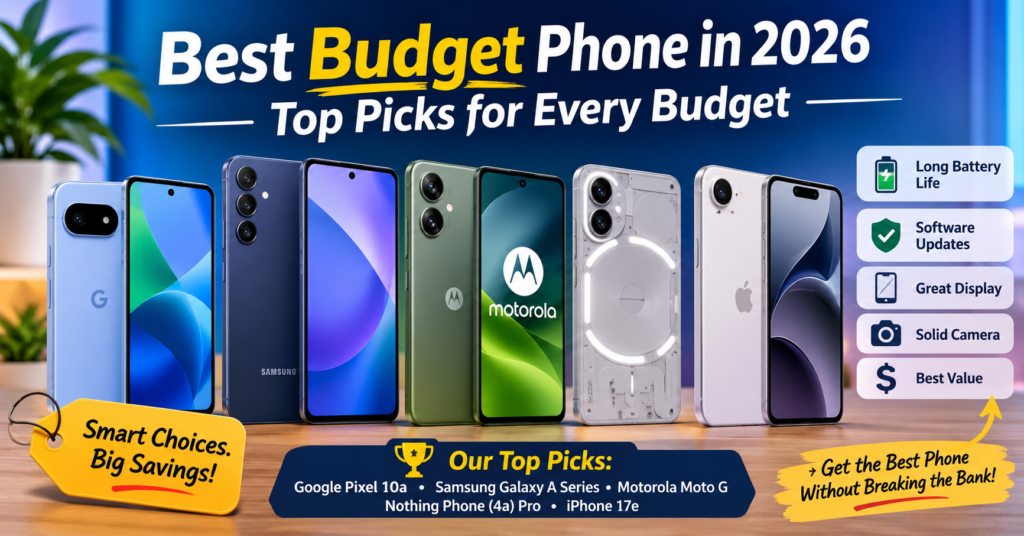
Best Budget Phone in 2026: Top Picks for Every Budget
Searching for the best budget phone in 2026? Compare top picks from Samsung, Google, Motorola, Apple and Nothing, plus buying tips.
Introduction
Phones keep getting more expensive, yet most of us still use them for the same things: messaging, maps, photos, video, and a lot of scrolling. That is why the best budget phone is often a smarter purchase than a flagship. You get what you actually use, and you keep a few hundred dollars in your pocket.
The good news is that budget phones in 2026 are far better than they were a few years ago. Bright OLED screens, solid cameras, and all-day battery life now show up on devices that cost a fraction of the top models. The tricky part is knowing which compromises are fine and which ones will annoy you six months in. This guide walks you through what to look for, which models stand out, and how to avoid the usual traps.
What Makes the Best Budget Phone?
A low price tag alone does not make a phone a good deal. A $200 phone that lags and stops getting updates after two years costs you more in the long run than a $450 phone you happily use for five. Before looking at specific models, it helps to know what actually matters.
Battery Life
Battery life is where budget phones often beat expensive ones. Cheaper phones usually have simpler chips that sip power, and manufacturers fill the extra space with big batteries. Motorola’s Moto G line is the best example. The 2026 Moto G posted one of the strongest battery results among cheap phones in independent testing, lasting well over 19 hours in a continuous test. If you hate hunting for a charger, put this near the top of your checklist.
Software Updates
This is the most overlooked feature and the one that matters most over time. Security updates protect your data, and new Android versions keep apps running smoothly. Samsung offers at least four years of security updates on its budget devices, while Google promises up to seven years on the Pixel 10a. A phone that is supported for that long can easily last you through a full contract cycle and beyond.
Display and Performance
Look for an OLED screen if you can. It gives you deeper blacks and better contrast than the cheaper LCD panels you find on entry-level models. For performance, don’t chase benchmark scores. A budget chip handles social media, video calls, and browsing perfectly well. Where it struggles is heavy gaming and demanding multitasking. Aim for at least 6GB of RAM, and 8GB if your budget stretches that far. Storage matters too, since 64GB fills up faster than you would expect.
The Best Budget Phone Picks for 2026
Different people need different things, so there is no single winner for everyone. These five phones cover the main ways people shop in this price range. Prices shift with sales and by region, so check current listings before you buy.
Google Pixel 10a: Best All-Rounder
The Pixel 10a is the safest recommendation for most people who want a well-rounded phone. It has a clean, ad-free version of Android, a stylish design, a capable camera, and that remarkable seven-year update promise. Reviewers also noted its battery life is among the best you can get at this price.
It is not perfect. Its Tensor G4 chip feels less snappy than rivals in some tasks, and the display is not as bright as you might hope under direct sun. But if you care about longevity, photos, and a smooth, simple software experience, this is hard to beat. It sits at the upper end of the budget range, so it suits people who see a phone as a long-term purchase.
Samsung Galaxy A Series: Best for Long-Term Support
Samsung’s Galaxy A phones are the dependable choice. The Galaxy A37 5G lands just under the $500 mark for the 128GB model, and it brings a bright display, good cameras, and Samsung’s polished software. The cheaper Galaxy A17 5G has also earned praise as a strong pick for people who want a reliable everyday phone without spending much.
The main downside is storage. Moving up to 256GB on the A37 can push the price past $500, so decide early how much space you need. Samsung’s updates policy and wide availability make these phones easy to service and resell, which counts for a lot.
Motorola Moto G Family: Best for Tight Budgets
If your budget is small, Motorola is the name to know. The standard Moto G (2026) is one of the best cheap phones you can buy, with excellent battery life, a stylish finish, and cameras that punch above their price. The Moto G Power costs more but adds a larger battery and a tougher build, which suits people who are rough on their devices or spend long days away from outlets. There is even a Moto G Stylus for anyone who wants a real pen for notes and sketching, which is rare at this price.
The trade-off is software support. Motorola’s update commitments are shorter than Samsung’s or Google’s, so these phones are better for people who upgrade every two or three years.
Nothing Phone (4a) Pro: Best for Style and Zoom
Nothing has built a loyal following by making budget-friendly phones that look different. The Phone (4a) Pro stands out for its zoom photography, which is unusual for a phone in this class, and it has a distinctive design that gets noticed. Its software is clean and fast, and it has won awards for its value.
It costs more than the Moto G models, so it is best for buyers who want something with personality and a better camera setup without moving into flagship territory.
iPhone 17e: Best for Apple Fans
If you are already in Apple’s ecosystem, the iPhone 17e is the budget option to look at. Launched in March 2026, it keeps the same price as the model before it while offering a faster chip, strong software support, and the polished experience iPhone users expect. Reviewers gave it top marks for value, and battery life lasts a full day, though it is no better than last year’s.
The compromise is that it costs more than the cheapest Android options, and you won’t find the same hardware extras. But for anyone who wants iMessage, FaceTime, and years of updates, it is the obvious pick.
How Much Should You Spend on a Budget Phone?
Think of budget phones in three tiers. Under $250, you get a perfectly usable phone for calls, messaging, and light browsing, such as the Moto G Play. Between $250 and $400, you start to see better cameras, faster charging, and nicer screens. Between $400 and $600, you are in near-premium territory, where the Pixel 10a, Galaxy A37, and Nothing Phone (4a) Pro live.
For most people, the sweet spot sits around the middle. Spending a little more usually buys you longer software support and a better screen, which are the two things you will notice every single day. If you only need a phone for the basics or as a backup, the lowest tier is perfectly fine.
Common Mistakes When Buying a Budget Phone
The first mistake is ignoring update policy. A phone that stops getting security patches in two years is a poor deal even if it is cheap today. The second is buying too little storage. Photos, videos, and apps pile up quickly, and a nearly full phone slows down and frustrates you. Choose 128GB if you can.
Another common error is trusting the megapixel count. A 108MP camera on a cheap phone does not guarantee good photos, because processing and sensor quality matter more. Read real camera tests instead of spec sheets. Finally, check 5G band support if you travel or use a smaller carrier. Some budget models, including certain Motorola phones, are tuned mainly for US networks and may not perform as well abroad.
Last, keep an eye out for seasonal sales. Black Friday and other big shopping events often cut prices on last year’s models, and a slightly older phone with a strong update policy can be a bargain.
Conclusion
The best budget phone depends on what you value. The Google Pixel 10a is the strongest all-rounder, the Samsung Galaxy A series offers dependable long-term support, and Motorola’s Moto G phones give you the most for the least. The Nothing Phone (4a) Pro adds style and zoom, while the iPhone 17e is the natural choice for Apple users. Focus on battery life, software updates, and a decent screen, and you will end up with a phone that serves you well for years without draining your wallet.
Frequently Asked Questions
For most people, the Google Pixel 10a is the best all-rounder thanks to its clean software, good camera, and seven years of updates. If your budget is tighter, the Moto G (2026) offers excellent battery life at a much lower price.
Between $300 and $500 is the sweet spot for most buyers. In this range you get better screens, stronger cameras, and longer update support. If you only need the basics, a phone under $250 can still do the job well.
They handle casual games without trouble, but demanding titles may need lower settings. If gaming matters to you, look for a phone with a faster chip and at least 8GB of RAM, and expect to spend toward the higher end of the budget range.
It depends on the brand’s update policy more than the hardware. A Pixel 10a with seven years of updates can last far longer than a cheaper phone that stops getting patches after two or three. Battery wear is usually the first thing to show its age, and batteries can often be replaced.
Yes, if you want an iPhone without paying flagship prices. It offers a fast chip, long software support, and the Apple experience. It costs more than most budget Android phones, though, so it makes the most sense for people already invested in Apple’s ecosystem.